Algo Forge: Build, Backtest and Automate Crypto Strategies
Turn an idea into a rule set, test it against history, then let it watch the market for you — with an AI assistant to help along the way.
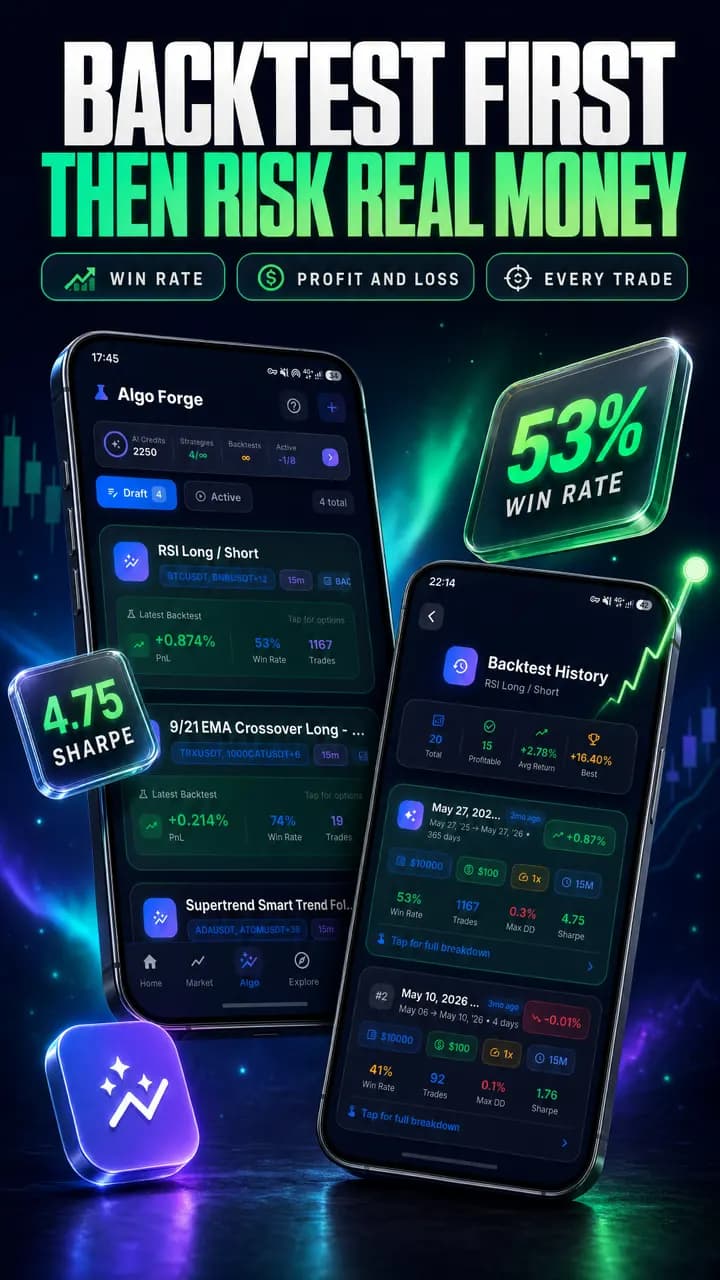
What you get
Build with indicators, not code
Combine RSI, MACD, moving averages, Bollinger Bands, Ichimoku, volume and price conditions into entry and exit rules with a tap-based builder.
Backtest on real historical candles
A dedicated Python backtest engine replays your rules against historical data and reports PnL, drawdown, trade count and a full trade log.
An AI assistant that speaks trading
Describe the idea in plain language and the assistant drafts the rules, explains an existing strategy or suggests why a backtest underperformed.
Go live with alerts
Run a strategy against live candles and receive a notification every time it produces an entry or exit condition.
Optional auto-trading
Connect an exchange and let the strategy place its own orders, with the same rules you validated in the backtest.
A community Marketplace
Publish strategies or subscribe to those built by other traders, organised by style: scalping, day trading, swing, trend following, mean reversion, breakout and momentum.
How it works
- Step 1
Define entry and exit rules
Pick a symbol and timeframe, then add conditions such as RSI below 30 and price above EMA 200. Add a stop-loss and take-profit rule.
- Step 2
Backtest
Run the strategy over a historical window. Review net PnL, maximum drawdown, the equity path and every simulated trade.
- Step 3
Refine with the AI assistant
Ask why the drawdown was large or how to reduce trade frequency; apply the suggestion and test again until the logic is sound.
- Step 4
Run live
Activate the strategy. Sindex evaluates it on each new candle and alerts you, or — if you connected an exchange — places the trade.
- Step 5
Share or subscribe
Publish to the Marketplace under a category, or subscribe to a creator's strategy and run it with your own settings.
Building a strategy from conditions
A strategy in Algo Forge is a set of conditions that must all be true for an entry, plus separate rules for the exit. Conditions are built from indicators you already know — RSI, MACD, EMA and SMA crossovers, Bollinger Bands, Stochastic, Ichimoku and volume — compared against a value, another indicator or price. Good strategies are short: an entry filter that defines the market regime, a trigger that times the entry and a hard stop. If you find yourself adding a sixth condition to make the backtest look better, you are probably fitting the past rather than describing an edge.
The AI chat assistant is useful here. It can convert a sentence such as buy pullbacks to the 20 EMA in an uptrend into concrete rules, and it can read back an existing strategy in plain English so you can sanity-check what you built.
Reading a backtest honestly
The backtest engine replays your rules candle by candle over the selected history and produces a trade log with entry, exit, size and result for every trade, an equity curve and summary figures. Net PnL is the number everyone looks at first; maximum drawdown is the number that decides whether you would have survived to see that PnL. A strategy that returned 80 percent with a 60 percent drawdown would have been abandoned by most people at the bottom.
Watch trade count as well. A great-looking result from seven trades is noise. Test across a window that includes both a trending and a sideways period, and compare a few parameter values rather than the single best one — if performance collapses when RSI 30 becomes RSI 32, the edge is not real. Fees and slippage are never zero on a live exchange, so treat backtest results as an upper bound.
Going live, auto-trading and the Marketplace
Once you are satisfied, activate the strategy. Sindex evaluates it on every new candle and sends a notification when a condition triggers, so you can execute manually. If you connect an exchange API key with trading permission, the strategy can place orders itself using the same logic. Start with alert-only mode for a couple of weeks to confirm that live behaviour matches the backtest before you let it trade.
The Marketplace is where creators publish strategies for others to subscribe to. Listings are grouped by style so a scalper and a swing trader are not sifting through the same list. Subscribers run a published strategy with their own symbol, size and risk settings.
Plans and risk
Algo Forge is part of the Premium plan. Backtests and AI assistant credits are metered per plan so the engine stays fast for everyone. Automated trading amplifies both good and bad logic: a bug in an exit rule can lose money on every candle until you notice. Use small sizes, keep exchange permissions minimal and review open positions daily. Nothing here is financial advice, and backtested performance does not guarantee live results.
Related strategies
Learn more
What Are Crypto Trading Signals? A Plain-English Guide
A crypto trading signal is a specific trade idea with an entry, targets and a stop-loss. Here is what a good one contains, where signals come from, and how to tell a real track record from marketing.
How to Backtest a Crypto Strategy Without Fooling Yourself
Backtesting tells you whether a trading idea has ever worked. Here is how to define rules, pick data, read the metrics that matter, avoid overfitting, account for fees and slippage, and move safely to live automation.
AI Crypto Trading Explained: What It Does and What It Can't
AI is everywhere in crypto marketing and almost nowhere in the explanations. Here is what AI trading systems actually do, what they cannot do, how to keep a human in the loop and how to judge whether an 'AI' product is real.
Other features
Frequently asked questions
- Do I need to know how to code?
- No. Strategies are assembled from indicator conditions in a visual builder, and the AI assistant can draft rules from a plain-language description. There is no scripting language to learn.
- What data does the backtester use?
- Historical candles for the chosen symbol and timeframe, replayed by a dedicated Python backtest engine. Results include net PnL, maximum drawdown, the equity curve and a full trade log you can inspect trade by trade.
- Can Algo Forge trade for me automatically?
- Yes, optionally. Connect an exchange API key with trading permission and an active strategy will place its own orders. Alert-only mode is the default and is recommended until you have watched a strategy behave live.
- What is the Marketplace?
- A community library of published strategies, organised into categories such as scalping, day trading, swing, trend following, mean reversion, breakout and momentum. You can subscribe to a strategy and run it with your own settings, or publish your own.
- Are there usage limits?
- Backtests and AI assistant credits are limited per plan to keep the shared engine responsive. Premium includes the highest allowance; the current limits are shown on the Pricing page.
Trade with an edge — get Sindex AI
Free to start. Real-time signals, AI strategies and portfolio tools on Android, iOS and the web.