 Sindex AI
Solana DEX & Memecoin Signals
A browser-free on-chain scanner that watches new Solana tokens, waits for a confirmed bounce and tells you exactly what it saw before you buy.
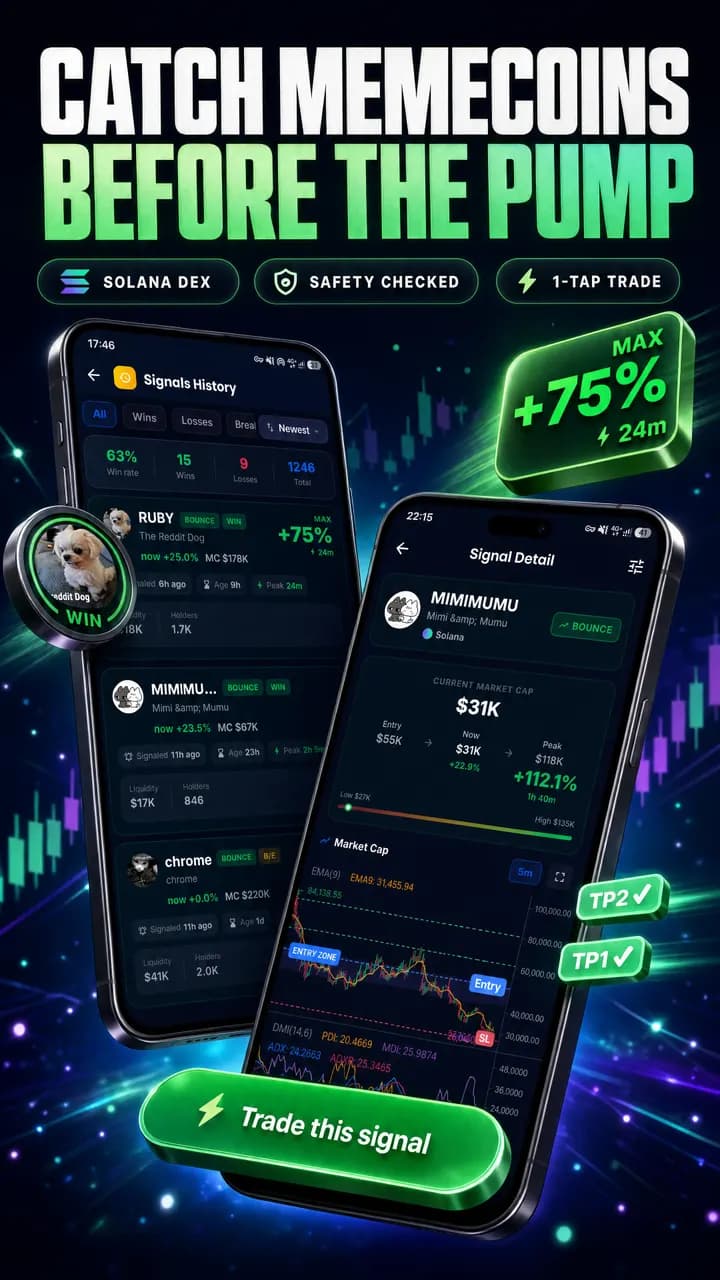
What you get
Built for Solana, read straight from the chain
The scanner reads on-chain pair data directly — no scraped websites, no browser automation — so signals are fast and do not break when a front-end changes.
A strength score you can filter on
Each signal carries a 0-100 strength score. Set your own threshold and only get alerted for setups above it.
The numbers that matter for a memecoin
Entry market cap, current and maximum market cap, liquidity, holder count and token age are shown on every card so you can spot thin or fresh tokens instantly.
Fibonacci retracement built in
Signals show where price sits between the recent high and low. Entries above the 0.74 level are filtered out because backtests showed they rarely recover.
Realistic take-profit caps
Targets are capped at +25%, +50% and +100%. That keeps the tracked results honest and stops a single 50x outlier from disguising a losing month.
Free to use
DEX signals are part of the free tier. You can watch the feed and its recorded outcomes before deciding whether Sindex earns a subscription.
How it works
- Step 1
New Solana pairs are discovered on-chain
The scanner picks up fresh tokens and tracks price, volume, liquidity and holders on a rolling basis without a browser in the loop.
- Step 2
Candidates go on WATCH
A token that meets the liquidity, age and volatility filters is put on watch. Watch entries are shown but never alert you — they are a heads-up, not a trade.
- Step 3
A BOUNCE is confirmed and the signal fires
When price bounces from a retracement level with the right structure, a BOUNCE signal is published with its strength score and full metrics, and you are alerted.
- Step 4
The signal is tracked to a verdict
Each signal ends as WIN, LOSS or EXPIRED, with the maximum gain reached recorded, so the feed's history is a real record and not a highlight reel.
Reading a DEX signal card
A memecoin signal looks nothing like a Bitcoin futures signal, and the card is designed around that. The headline is the signal type — BOUNCE for a confirmed entry — and the strength score from 0 to 100. Below it you see entry market cap, current market cap and the maximum market cap reached since the signal fired, which together show how far the token has moved and whether you are late. Liquidity tells you how much you can buy or sell without moving price; holder count and token age tell you whether a coin has a real base of buyers or is a few hours old with a handful of wallets.
The Fibonacci block shows where the entry sits relative to the recent swing. A reading near 0.5 means price has given back half of its run; a reading near 0.74 is the ceiling Sindex allows. The max gain field and the outcome badge (ACTIVE, WIN, LOSS or EXPIRED) update live, and the take-profit ladder — +25%, +50%, +100% — shows which caps have been hit.
Why the filters are set the way they are
Sindex does not chase every green candle. The filters are derived from replaying historical signals on five-minute candles, and two of them carry most of the weight. First, the Fibonacci level must be at or below 0.74: tokens that had already retraced more than that were far more likely to keep bleeding than to bounce. Second, a coefficient-of-variation threshold on recent price action screens out tokens that are either dead flat or so erratic that a stop-loss would be hit by noise. Tokens that fail either test never become signals, no matter how loud the social buzz is.
Capping targets at +25, +50 and +100 percent is a deliberate choice. Memecoins occasionally run 20x, but building a strategy around outliers is how people give back everything on the next ten trades. The caps make the recorded results comparable across signals and make it obvious when the market is not cooperating.
Managing risk in memecoins
Memecoins are the highest-risk corner of crypto. Liquidity can vanish, developers can dump, and a token can lose 90 percent in minutes. Treat every DEX signal as a lottery-ticket-sized position: an amount you would be fine losing entirely. Check the liquidity figure against your order size and expect slippage; on a thin pair even a modest buy can move the price against you. Prefer tokens with a wider holder base and some age over ones that launched an hour ago.
Have an exit before you enter. The take-profit ladder gives you natural points to sell a third of the position at +25 and +50 percent, and a stop below the bounce low tells you when the idea is wrong. Sindex signals are analysis, not advice. Past outcomes shown in the feed do not predict the next signal. If you would not be comfortable explaining the trade to a skeptical friend, do not take it.
Related strategies
Learn more
What Are Crypto Trading Signals? A Plain-English Guide
A crypto trading signal is a specific trade idea with an entry, targets and a stop-loss. Here is what a good one contains, where signals come from, and how to tell a real track record from marketing.
How to Read Crypto Signals: Entry, Targets, Stop-Loss Explained
A worked example of a futures long signal, field by field: what the entry range, three targets, stop-loss and leverage mean, how to size the trade, and how a stepwise lock-in exit protects profit.
Solana Memecoin Trading: A Survival Guide for DEX Tokens
Solana memecoins move faster and die faster than anything on a centralised exchange. This guide covers how launches work, the on-chain numbers that matter, how rugs and honeypots trap buyers, and how Fibonacci bounce setups and strict take-profit caps keep you alive.
Other features
Frequently asked questions
- Which chains are supported?
- The DEX scanner is Solana-only. It reads pair data directly on-chain, which keeps signals fast and reliable. Other chains are not scanned at this time.
- What is the difference between WATCH and BOUNCE?
- WATCH means a token has passed the basic filters and is being monitored; it is shown in the app but never triggers an alert. BOUNCE is a confirmed entry with a strength score, and it is the only signal type that notifies you.
- What does the strength score mean?
- It is a 0-100 composite of how well the setup matches the conditions that historically led to bounces — retracement depth, volatility profile, liquidity and holder structure. Higher is better, but a high score never removes the risk of a rug or a sudden dump.
- Are DEX signals free?
- Yes. The DEX memecoin feed is included in the free tier with its full history and outcomes. You do not need Pro or Premium to use it.
- Does Sindex buy the token for me?
- Signals are information. You trade through your own wallet or DEX interface. That keeps custody of your funds with you at all times.
Trade with an edge — get Sindex AI
Free to start. Real-time signals, AI strategies and portfolio tools on Android, iOS and the web.